
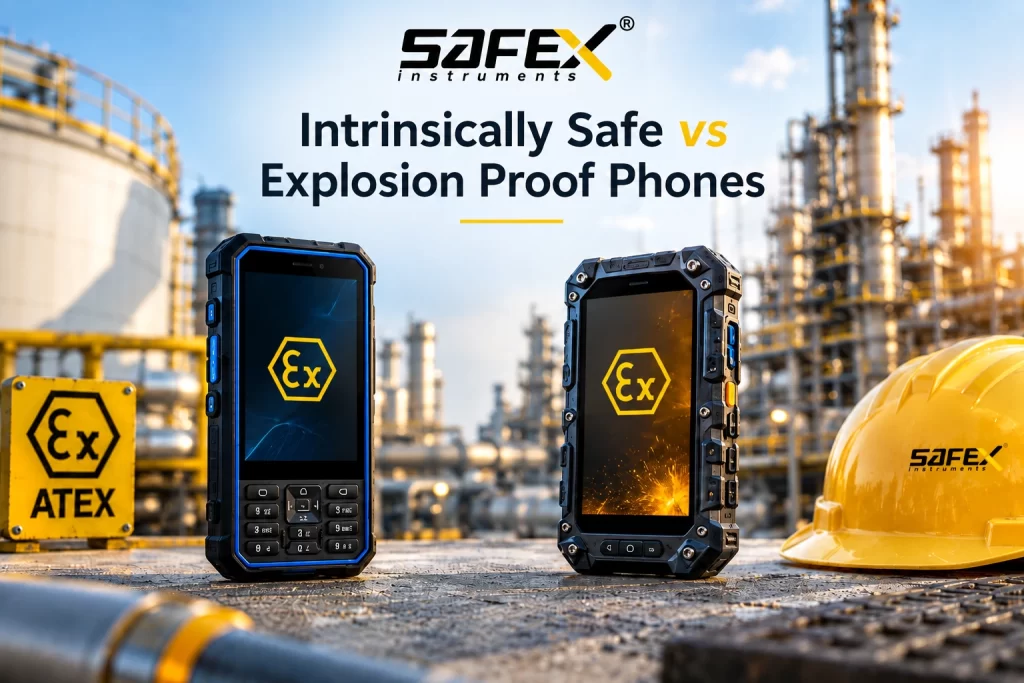
If you’ve started shopping for a phone that’s safe in a hazardous area, you’ve probably met two terms that sound almost identical: intrinsically safe and explosion proof. Suppliers swap them around. Some data sheets use both on the same page. So are they the same thing?
Not quite. And getting it wrong can mean buying the wrong device, failing a site audit or, in the worst case, putting people at risk. This guide explains the difference, shows you how to read the certification labels, and helps you pick the right phone for your zone.
Why can’t a normal phone go into a hazardous area?
Fire needs three things: fuel, oxygen and something to set it off. In a refinery, a grain silo or a chemical plant, the first two are simply part of the workplace. Flammable gas, vapour or dust is in the air, and so is oxygen. You can’t remove either.
So hazardous-area safety comes down to controlling the third ingredient: the ignition source. And a standard smartphone is packed with potential ones:
- Electrical sparks from a damaged battery, a charging port or a loose connector.
- Hot surfaces, because processors and batteries warm up, and some gases ignite at surprisingly low temperatures.
- Static discharge from plastic casings and the person handling them.
- Radio energy, since a phone is a transmitter and certification has to account for that too.
The “Ex” marking you’ll see on certified equipment signals explosion protection, and there are several engineering methods for shutting those ignition routes down. Two of the best known are intrinsic safety and explosion proof design.
What does “explosion proof” actually mean?
Explosion proof equipment is built to contain an explosion, not prevent one. Its enclosure is strong enough to withstand an ignition inside, and its joints (called flame paths) are machined so precisely that any escaping gases cool below the ignition point before they reach the atmosphere outside.
Think of a bank vault. It doesn’t stop something from going off inside. It just makes sure nothing gets out.
In ATEX and IECEx language this protection method is officially called flameproof. It’s marked Ex d and covered by IEC 60079-1. In North America you’ll also meet the term “explosion-proof” in the Class/Division system, for example Class I, Division 1.
A quick myth-buster: “explosion proof” doesn’t mean a device can survive a blast happening around it, or that it’s indestructible. It means it has been tested and certified so that an ignition inside it can’t spill out.
Flameproof enclosures are brilliant for motors, switchgear, junction boxes and lighting. For a handheld phone, though? Thick walls, heavy glass windows and sealed joints don’t play nicely with antennas, touchscreens and slim batteries.
What does “intrinsically safe” mean?
An intrinsically safe (IS) device is designed so it can’t release enough electrical or thermal energy to ignite a specific explosive atmosphere, even if something goes wrong. It’s prevention rather than containment. The protection type is Ex i, defined in IEC 60079-11.
Engineers get there by capping voltage, current and power, limiting the energy stored in components like capacitors and inductors, and keeping surface temperatures below the ignition temperature of the gas or dust in the area. Then the design is tested against fault conditions such as short circuits and component failures, to prove it stays safe.
How little energy are we talking about? Some gases, hydrogen for example, can be ignited by a spark of a small fraction of a millijoule. That’s less than the static zap you get from a door handle on a dry day. Intrinsic safety keeps a device’s energy comfortably below those levels.
Not every IS rating is equal, though. The letter after “Ex i” tells you how much fault tolerance the design has:
| Level | Fault tolerance | Suitable for gas zones |
| Ex ia | Stays safe with up to two independent faults | Zone 0, 1 and 2 |
| Ex ib | Stays safe with one fault | Zone 1 and 2 |
| Ex ic | Safe in normal operation | Zone 2 |
Intrinsically safe vs explosion proof: side-by-side comparison
| Intrinsically safe (Ex i) | Explosion proof / flameproof (Ex d) | |
| Core idea | Prevents ignition by limiting energy | Contains an explosion and stops it escaping |
| Main standard | IEC 60079-11 | IEC 60079-1 |
| Marking | Ex ia, Ex ib or Ex ic | Ex d |
| Typical zones | Zone 0, 1 and 2 (depending on ia, ib, ic) | Zone 1 and 2 (not used for Zone 0) |
| If a fault happens | Energy stays below ignition level | An internal ignition can occur, but the enclosure contains it |
| Typical build | Compact, lightweight, electronics designed around energy limits | Heavy, thick enclosure with precisely machined flame paths |
| Common devices | Phones, tablets, radios, cameras, handheld instruments, sensors | Motors, switchgear, junction boxes, lighting |
| Handling rule | Use only approved batteries, chargers and accessories | Never open in the hazardous area; keep flame paths undamaged |
Why are most hazardous-area phones intrinsically safe?
Because a phone isn’t a motor. It has a lithium battery, radios, a screen, a camera and speakers, and it has to fit in a pocket. Intrinsic safety lets designers build all of that around energy limits instead of wrapping it in a heavy shell. The result is a lighter, slimmer device that people will actually carry, which is the whole point.
That’s the approach behind the Safex Ex Mobile 20, an intrinsically safe phone built for hazardous environments. It also explains why “explosion proof phones” is used across the market as a catch-all for phones that are, technically, intrinsically safe.
Curious about the basics? Our guide to what an intrinsically safe mobile phone is covers them in more depth.
Five checks before you buy
- Ask for the certificate, not just the brochure. That means an ATEX EU-type examination certificate and/or an IECEx Certificate of Conformity.
- Look for the Ex marking on the device label itself.
- Match the zone, gas group and temperature class to your site. The next section shows how to read them.
- Confirm the certificate covers the exact model, battery and accessories you plan to use.
- Verify IECEx certificates in the IECEx online certificate database to make sure they’re genuine and current.
Conclusion
Intrinsically safe and explosion proof aren’t rivals. They’re two different answers to the same question: how do we stop a spark from becoming a disaster? One prevents the ignition. The other contains it. For handheld phones, prevention wins almost every time, which is why intrinsic safety has become the standard approach.
What matters most isn’t the words on the box. It’s the certificate behind them, the marking on the device, and how well both match the zone your team actually works in.